Thursday, May 29, 2008

Arenal and Monteverde

WOWWW.... Seriously one of the coolest weekends of my life!... Ok so I guess I will start on Friday. We left San Jose for the town of Fortuna where the Arenal Volcano and many other landmarks are located. When we got to the hotel, which was more like a motel, we all changed into our bathing suits and headed off to the Hot Springs at teh base of the volcano. This place had 12 different temperature hot springs, but the first thing we saw was the slide. We all ran up the stairs and expected the normal medium paced slide that you go down once and get bored with. But we were totally wrong. This slid was the fastest, most dangerous water slide I have ever been on, and we all decieded it probably wouldn't have even been allowed in the U.S. It only has two turns but you whip down the second one so fast that you almost reach the edge of the slide and you definitely feel like you are going to go flying right off the side. Then after this second turn you rocket down to the bottom and your whole body slides on top of the water at the end because you are going so fast. it was so fun to watch people come down the slide because their bodies would fly in every direction haha. I got airborn coming around the second turn and flew for a few feet above the water at the end, and it was amazing! Pretty much everyone had brusies after their first time down but we all loved it and proceeded to g down at least 5 more times! So after we got done with that, a few of us decided to try the hottest spring that they had at this place. When we first stuck our feet in we all thought we would never be able to get in. It took us all a while and a bunch of the guys got all the way in after a few minutes, and I followed behind, inching my way lower and lower into this burning water. Eventually I got all the way in, and Paul and I were the first out of the whole group to dunk our heads under! We are the only ones with pictures to prove it too haha. We had no idea how hot it really was, so when we checked we were all pumped to see that it was 152 degrees!!! By the end of the night we all got in, which completely trumps last years group, in which only one girl was able to get in this hot spring. We were all so excited and we spent the rest of the night drinking at the bars in the hot springs, despite how rediculously expensive the drinks were... $6 bucks for a beer!


The next day we went horseback riding from the stables to the waterfall at Arenal. I had never ridden a horse before so I was pretty nervous and didn't know what to expect, but it turned out to be so much fun. We rode for about half an hour through fields and creeks, all with stunning views of the volcano and the surrounding mountains. Plus, we got to actually gallop and go fast on the horses which was hilarious and so much fun. The guides didn't have any restrictions for us so we could go as fast or slow as we wanted, depending on what the horse was willing to do. Apparently I had the mean horse because it actually attempted to bite Heidi, Heidi's horse, and Nolan! And I of course had no idea how to control this huge animal so it was quite an adventure for me. Horseback riding was definitely a new experience that I really loved. We rode the horses all the way to the waterfall where we had to go down what seemed like 500 steps that were actually just rocks. It was scary going down because if you made one wrong step you could have easily rolled down the cliff that was 2 feet to the left of the steps. Eventually we made it down and the views of the waterfall were stunning. We all swam in the crystal clear waters, which were decently cold especially compared to the hot springs the night before, and climbed along the rocks behind the waterfall. I have never seen anything so gorgeous and we all had a blast. After returning to the hotel to change, we headed off to the lava fields on the other side of the volcano. To get there we had to walk through a forest that had paths that were carved in it by eruptions from the volcano many years ago. We could even hear the popping of the volcano, which sounded exactly like popcorn. Once we got to the lava field we had to climb rocks and we were able to see stunning views of the lake from the tops of some of the large black rocks. It was unlike anywhere I had ever been before and it was cool to be somewhere that hot lava had run through only 30 years ago. We went back to the hotel right after and came back to a power outage in the town! Luckily we all had flashlights and we drank and played cards by flashlight and candlelight. AND, we got to see the volcano spitting up orange lava! It was so cool and apparently it is rarely visible because of the clouds that normally engulf the top of the volcano.


The next morning we took what is called the "jeep boat jeep" route from the town of La Fortuna to Monteverde way up in the mountains of Costa Rica. However, it was more like van boat van, as jeeps would have been way too expensive. We took a very slow boat across the lake and got to take in the scenery (unfortunately I forgot my camera so I don't have any pictures). We then took old vans on the worst, oldest roads I have ever seen for about two hours! We travelled up the mountains and I could have sworn the vans weren't going to make it up some of the steep slopes. We were driving on rock roads with millions of potholes but it was fun because the drivers were crazy... they would whip around turns and our wheels would skid and everything. I felt like I was in a car chase through the mountains. The veiws from up top were again gorgeous, and we could see the volcano, the lake, small farms in the valleys, and everything you could possibly imagine seeing from the top of these mountains. Eventually we got the our hotel in Monteverde, which was set up more like a summer camp with bunk beds and everything. The Monteverde Reserve is in a cloud forest high up in the mountains where there is 100% humidity. It rained the whole time we were there and absolutely noghting dried, not even my hands in the bathroom under the hand dryer. We ate lunch and got ready to go ziplining through the rainforest!! AHHH! this was honestly one of the most exciting and thrilling things I have ever done, even in the pouring rain. The guides strapped us in, gave us a few instructions, and we were off. They clipped us in at the first station and we slid down to the next. There were a total of 13 ziplines, the next longer than the other. At the end of one of the middle ziplines, I did a free fall from about three stories up!! They attached me to a rope and I screamed on the way down, and they stop you by tightening the rope. It was the first free fall I've ever experienced and it made me so excited to go bungee jumping! Right after the free fall was the TARZAN SWING! We had to climb about 50 stairs to the top of this metal structure wher the guides strapped us to a rope that was attached to a huge tree limb above the canopy. As soon as they opened the gate they literally pushed you off and you fell for a story or two and then swung just like Tarzan low to the ground and then up above the canopy. It was amazing!! We still had a few more ziplines to go and the last two were definitely the best. They were both 2400 meters long and flew above the canopy. Th clouds were so low that you felt like you were sliding into an abyss, as you could see only whiteness in front of you and the green of trees below you. Ziplining through the rainforest is something that I will never forget, and I highly recommend it to everyone!


Later that night we had a night tour of the cloud forest in the pouring rain. This was very exciting, and we saw a number of different kinds of bugs, trees, and insects. We saw bats, one which almost hit Steve in the face, and a tarantula!! This thing was huge and had orange stripes, and I have never seen a scarier spider. We had to turn our flashlights off at one point and we discovered exaclty what pitch black really is.. I could not see and inch in front of my eyes. That night we played Mafia in the hotel haha, and we discovered so many different kinds of bugs in our bathroom, enough to make me not even shower that night. The next morning we did a morning walk through the rainforest where we saw plenty of birds and another gorgeous waterfall. Many of the groups saw the famous quetzal, a green and blue bird native to Costa Rica, which thousands of people come searching to see every year. It rained again all day and we were all pretty eager to get out of there. The drive back was long in our huge tour bus and I took a bunch of pictures. That was the end of our amazing weekend, and despite the rain, we all had a blast!

Bananas

Bananas currently account for over 7.1% of Costa Rica's export revenues. In 2007 alone, Costa Rica exported over 2 billion kilos of bananas to other countries such as Belgiium, Germany, and the UK. Because of the large amount of income that it brings to the country, banana production is very important in the Costa Rican economy and culture.
Costa Rica was the first Central American country to produce bananas, which began in 1878 after Minor C. Keith was commisioned to build a transnational railroad. Since he needed cargo and passengers for this new railroad, he planted bananas alongside the tracks to provide paying fares both inland and back to the sea. In 1899, Keith and his railroad companies merged with the Boston Fruit Company to form the United Fruit Company. Costa Rica became the world's largest producer of bananas in 1911, and it has continued to reamin as one of the top producers and exporters of bananas in the world since then.
Currently, bananas are cultivated in the Estrella and Matina valleys, in the lowlands of Santa Clara, in the area of Sixaola river, and in parts of south-west. A little more than two thirds of all bananas are exported by Chiquita, BANDECO (Del Monte) and the Standard Fruit Company, which is more commonly known as Dole.

Monday, May 26, 2008

Eco-Tourism

Costa Rica is currently focusing on ecotourism as its key economic development. Ecotourism is defined as "environmentally responsible travel to natural areas, in order to enjoy and appreciate nature (and accompanying cultural features) that promote conservation, have a low visitor impact and provide for beneficially active socio-economic involvement of local peoples." Eco-tourism is currently booming all over Costa Rica, especially in places like the Monteverde Reserves, Lake Arenal and surrounding forests, The Arenal Volcano, beaches on the Pacific and Carribean sides of the country, and in its many rainforests. Costa Rica has used ecotourism to stimulate the economy and to promote conservation and sustainability. Ecoutourism brings money into the towns and cities that attract people from around the world. It also brings jobs to Costa Rica because many people are needed to work as tour guides, in hotels, on beaches, in new restaurants, and a variety of other places. In this way, ecoutourism substantially benefits the Costa Rican economy and the lives of many natives in the country. Ecoutourism also serves to provide visitors with knowlegde and information about conservation and preservation. This type of tourism works to preserve the land, not drain it of all its resources like most tourist destinations seem to do. Sustainability and environmentalism are promoted, and eco-friendly hotels are built while tour guides teach visitors what is so beautiful about nature and why it should be preserved. Costa Rica sets an example for the world in this field, as nearly 28% of its land is set aside as reserves and protected areas. In this way, extinction of thousands of species of plants an animals has been prevented using ecotourism, compared to bringing money into the country through other things like industry.


This past weekend we visited the Reserves of Monteverde which are cloud forests up in the mountains about 4 hours north of San Jose. The town of Monteverde was founded by Quakers from the U.S. who moved to Costa Rica in the 1950's. They left the U.S. because they did not want their sons to go to war, and they chose this new place because they discoverd that Costa Rica had abolished its army in 1948. The Quakers immediately took a stance of environmentalism as soon as they arrived, choosing to preserve as much of the rainforest as possible. The Monteverde Reserves are now the most desired tourist destination for people around the world. The variety of species, including over 850 species of birds, can be found in these reserves, including the beloved quetzal, which is a green and red bird that is native to Costa Rica. During our visit we took both a night walk and an early morning walk through the cloud forest with expert guides. They explained to us why ecotourism is so important for the country, and how global warming is having an affect on the cloud forests. Warmer temperatures are changing the environment for many animals. For example, our guide mentioned that their is a certain type of catepillar that grows fungus on its skin, but as temperatures are rising, many of these catepillars have died because the fungus is able to grow to much and it eventually kills its host. Also, the golden tree frog that was native to Costa Rica is now extinct due to overcapture of these gorgeous creatures. A golden tree frog has not been seen anywhere in Costa Rica for the past 20 years. These are just two of the many examples as to how changes in the earth's climate due to human pollution and carbon emissions have affected plants and animals in the rainforest.


All in all, ecotourism has been a great success for Costa Rica, and many nations are following its lead. It has set a great example as to how one can use nature to benefit the economy without destroying it, and hopefully this idea continues to catch on throughout the world as the trend to "go green" becomes more and more popular. Ecotourism has brought jobs and tourists to Costa Rica, all in the hope of preserving its natural areas and showing the world how gorgeous nature really is.

Friday, May 23, 2008

My Host Family

We had one of the most interesting dinner conversations with Fernando today.  Just out of curiosity, we asked how long Fernando and Carmen have lived in Costa Rica, because they had told us earlier that they were originally from Peru.  Fernando told us that they have lived here for 14 years, so we asked him why he moved.  This is where it gets interesting.  He told us his whole story in Spanish so I am not 100% positive that my interpretation is correct, but I hope it is close enough.  He explained that a revolution started in Peru that pitted the native Peruvians against U.S. intervention and thus any white people in Peru or any Peruvians that had foreign relations.  (Here is a website about the revolution that I found in case you want any more information:  http://www.csrp.org/history.htm).  However, many of the revolutionaries decided to use terrorism as a means of getting what they wanted.  Fernando was an important engineer and business man in Peru, so he must have had relations with U.S. companies, and he wanted no part of the terrorism.  Also, he may have owned part of the cell phone company Nokia, and because of the revolution it went bankrupt in Peru, and somehow he owed someone $150,000 dollars.  The terrorists wanted him to join their cause against foreign intervention in Peru and told him and many other families that if they didn't their wives would be hung and their children would be killed.  One day, his children went to a party, and the terrorists threw dynamite over the wall into the party, severing children's arms and legs and killing a few people.  Luckily, his children were ok, but this is when he decided to leave the country.  He spoke with such fervor about his hate for the terrorists and how no one could live like this.  So, this is why Fernando and Carmen and their family came to Costa Rica, and he has worked to pay off the $150,000 of debt that he owed.  The revolution is over now, and Peru is again a peaceful and beautiful country.  Fernando has thought about returning, but he has already been in Costa Rica for 14 years and it would be hard to leave his businesses here and start all over again.  
Fernando's story really made me appreciate how lucky I am to never have gone through such terror, and to live where I do. Life in Hinsdale is nothing close to real life and it cannot even compare to how other people have lived their lives. I am incredibly blessed and I wish Fernando and Carmen a peaceful and happy life from now on.  

Thursday, May 22, 2008

Fun Stuff

How did people communicate before their were cell phones???? Last night we had a little debacle on our way to the bar. A few of us were supposed to meet Bob and John at the university so that we could all walk to the bar together. After waiting for 20 minutes after we were supposed to meet, they still hadn't shown up, and we were so confused because it was Bobs Birthday! He had to be going out, right? So we decided that they weren't coming and we trudged through the rain to Pescaditos. It is a very small bar, but they do have a projector screen that is constantly playing soccer games on tv! It was awesome to sit and drink and watch some great soccer action. After about an hour of hanging at the bar, Bob and John walked through the door and explained that they had been waiting for an hour for their taxi to pick them up! If we had had cell phones we would known where the heck they were and that they were actually coming to celebrate.


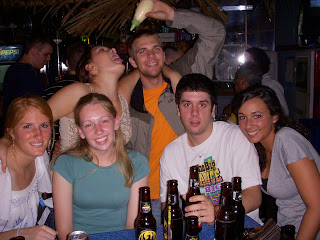
I discovered last night at the bar that they sell Light Imperial so I was pumped! We all had a blast that whole night. And we found out that there are a bunch of us that will be living within a block of each other at school next year!!! I also discovered that beth lives in Woddstock, IL which I drive right through every time I go to my lakehouse, and that she comes up to Lake geneva pretty often.. so hopefully we will see each other up there! the night was awesome and we all can't wait for our 6 day vacation starting this weekend! Here are a few pictures:

Organic Coffee Production in Costa Rica

Today we visited an organic coffee plantation called Cafe Britt. We were all shocked on our drive their that we didn't have to climb mountains to get their, as it was in the middle of a city. We later found out that this was just the tourist location of Cafe Britt's company, and was not the place where their real coffee is grown. The tour was very informative and it was probably more of a theatrical presentation than a tour. We learned just abou everything about coffee, including the precise processes of taste testing and smell testing. After both of these trips to coffee plantations, I really wished I liked coffee! It smells so good but tastes so bitter. Like Daisy's brand of coffee, the coffee of Cafe Britt is grown high up in the mountains. However, Cafe Britt has been producing "certified organic coffee since 1991." Unlike inorganic coffee production, organic coffee is not cultivated with pesticides or other unnatural fertilizers to improve growth and efficiency of the plant. Cafe Britt uses 100% organic materials to improve and fertilize their soil, which ensures soil quality anp protects ground water. They pick all of their coffee manually and use water to separate the fruit from the beans. Cafe Britt buys all of their plants from growers who consistenlty produce orgainc coffee and that are certified in the organic business. Also, Cafe Britt practices fair trade. This means that they pay their suppliers prices higher than that of the market because of their outstanding quality. Beause they are a giant company, Cafe Britt can afford to practice fair trade and produce organic coffee. They bring in enough profit to cover the large costs of production, which is nearly impossible for small plantation owners such as Daisy Rodriguez. Cafe Britt helps their growers to be as efficient as possible because they believe in improving the sustainable development of coffee production in Costa Rica.

Wednesday, May 21, 2008

Inorganic Coffee in Costa Rica


Coffee production in Costa Rica first began in 1779 after the plant was brought over from Saudi Arabia. This first type of coffee was of the Arabica species, and it is still the top species grown today. By 1829, coffee had surpassed all the other products produced in Costa Rica to become the number one source of revenue. Coffee remained at the top of the export list for a long time, but currenlty it accounts for less than 10% of exports. This is not necessarily because coffee demand has decreased but because of the Central American Free Trade Agreement that has encouraged thousands of businesses to invest here in Costa Rica. These foreign businesess are atrracted by tax incentives and their products now account for a majority of exports. The Free trade Agreement also lowered tariffs on trade between countries in the Americas, which has allowed coffee exports to increase, despite the percentage decrease in total exports from Costa Rica.

I remember reading in one of our books that Costa Ricans do not produce a substantial amount of coffee, but they pride themselves on the excellent quality of their coffee. In order to learn more about this well known industry here, we visited a family owned Coffee Plantation in the mountains of the town of Alejuela. The bus trip there was quite terrifying because we had to travel on skinny dirt roads that were full of rocks and potholes up the side of this mountain in our gigantic charter bus. I'm pretty sure we were all shocked that we made it as high up the mountain as we did, or that we didn't get hit by other passing cars because the roads were so tiny! The slopes of these dirt paths were so steep that I really thought the bus was going to roll backwards at any moment. Eventually the bus had to stop and we set off on foot towards the plantation. We took tons of pictures along the way of the gorgeous views from way up there. Farming here is so much different from the Great Plains where everything is flat. Plants are grown on steep slopes up and down hills, and they are all surrounded by ¨natural¨ fences, which were mainly large trees or tropical bushes to separate areas of farmland. The natural fences really made everything so pretty.


The plantation is owned by a local business woman named Daisy and her husband, and they produce their own brand called Del Cafe Tal. They grow coffee at the highest possible altitudes up in the mountains, which is optimal for coffee growth. Daisy is involved in the entire business, as she grows the plants, collects the beans, dries them, roasts them, and brews the coffee at a little store in her town. She recently won the award for the best coffee in Costa Rica, and Costa Ricans always claim that if you are the best in Costa Rica you are the best in the world when it comes to coffee. The plantation was gorgeous and the views were even better. Daisy and her husband were originally inorganic coffee farmers, and they followed the normal practices of fertilization and using pesticides so that they could produce the largest amounts of coffee beans possible. When the trend came around to switch to organic growth, they jumped on the bandwagon and tried it out. However, organic coffee growing was very difficult for the family because the increase in revenue was minimal and was not worth the extra work. Also, the switch from inorganic to organic reduced the number of sacs that the plantation produced from 800 to only 30. Thus, their profits greatly decreased and it was very difficult to sustain the business. Daisy and her husband also explained that the coffee business is very corrupt (which is not that shocking because it seems that a lot of business practices here are corrupt as well). She said that many inorganic farmers claim that their coffee is organic in order to get better business. After 3 years of struggling to make a profit with organic coffee, Daisy and her husband switched back to inorganic practices. She continued to receive only $1.50 per pound of her coffee sold. However, she recently just won the award for best coffee in Costa Rica, and this will allow her to receive almost $15 per pound! Don't worry Mom, I bought a bag of her coffee and I will be bringing it back home... everyone in the group who tried it said it was delicious!

It seems as though organic coffee is a very difficult crop to produce in Costa Rica because of the corruption and the minimal increase in revenue. Small farmers like Daisy cannot compete with the larger companies such as Starbucks that are able to produce organic coffee at much larger volumes that bring in larger profits.